

What's Up on WhatsApp: Navigating Chat Dynamics
- Germaine Chow

- Nov 15, 2023
- 5 min read
Updated: Nov 18, 2023

In Part One, the focus was on the importance of taking time as a family to discuss and select the privacy settings that suits your child and your family. In this post, we will be diving into your child's engagement in the chats and ways we can support positive chat dynamics.
1. The person with whom you are chatting with...
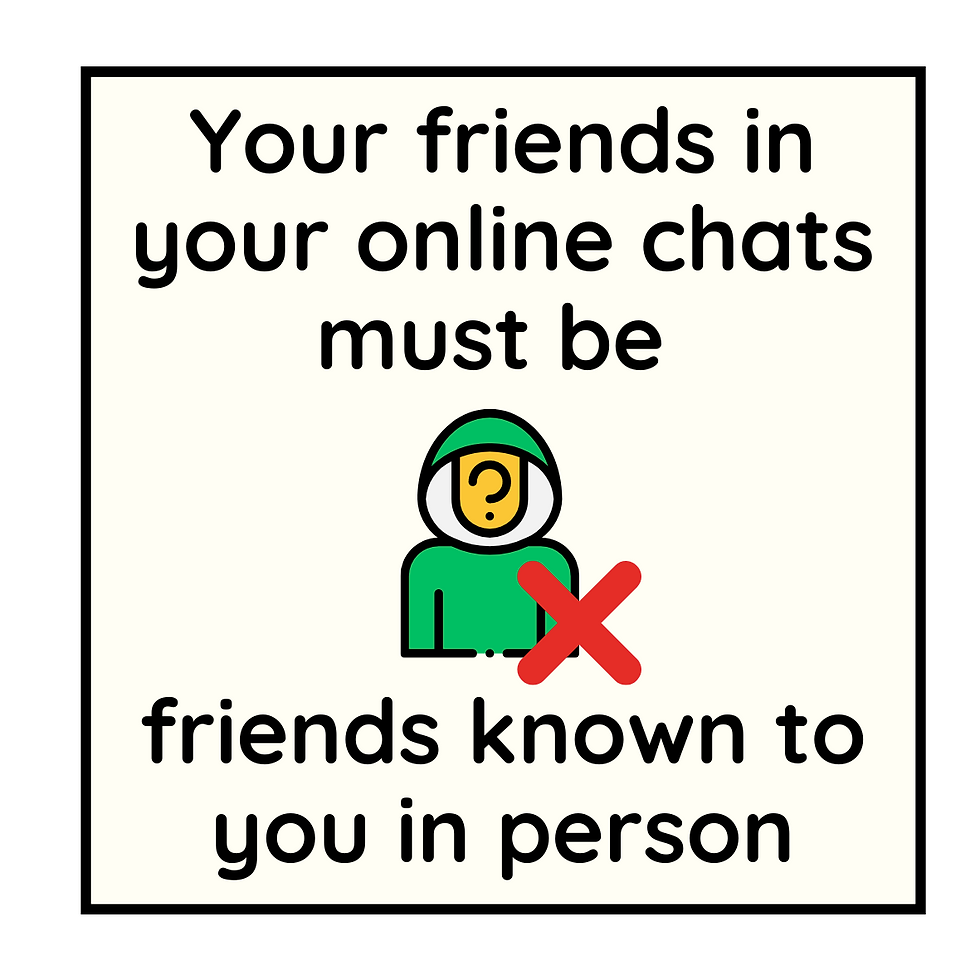
...Has to be someone you know in person! This is the minimal safeguard that needs to be agreed with your teen. This means no strangers and default 'blocking' of any unknown number that appears on WhatsApp. It is crucial that this is established as it will significantly safeguard your teen from unwanted contact from predators or scammers.
As a general rule of the thumb, the conversation that I have with my teen is to only use WhatsApp with friends who she deems are close friends and are not simply 'a friend from school whom she doesn't often speak with' or 'the cousin/sibling of a friend'. These clear definitions and boundaries are important so that your child already feels comfortable with their friends' interactions in person and thus can better predict their interactions online.
The younger your teen, the more specific and descriptive you should be with your definition of a 'friend' - e.g. someone who we will invite to our home for a playdate, or someone who is and whose parents are known to our family. At the teenage years whereby the quantity of 'friends' can often be associated with their perceived popularity and hence the temptation to have as many friends online, it is essential that us parents do not assume that our children has the clarity to decide who they should add and engage with conversations online.
Take the opportunity to highlight to your teen that more often than not, inappropriate interactions and content sharing are perpetuated by friends known to the recipients. Thus, even if they are chatting with friends online, they will still need to be alert and know how to safely navigate the dynamics within their chats.
2. Content Sharing
With growing trends of sexting as well as the prevalence and access to inappropriate images and videos, content sharing is an important aspect to speak to your teen before handing over the reins for their independent use of any messaging platform. Teens must be alerted to the possibility of a false sense of privacy that they may have on WhatsApp.

WhatsApp has the end-to-end encryption feature which means that only participants within the chat can view and read the content sent. Message privacy is deemed more secure as third parties (WhatsApp, government bodies or hackers) would not be able to see the contents of the chat. On the other end of the double-edged sword, this also means that the chats cannot be monitored for any illegal activity.
Coupled by the 'View Once' feature which allows photos and videos to disappear once they have been opened or expire after 14 days if unopened, teens can be lulled into a false sense of security that their message will only be viewed once by the intended recipient. If they are being coaxed and persuaded by their peers or predators to share inappropriate or sexual content, the 'view once' and 'end-to-end encryption' may make them more inclined to be trusting and "assured" that no one else will see what is being sent. Whilst the 'View Once' privacy feature is meant to prevent image/video from being saved, shared or forwarded, a quick Google search will reveal many hacks around this, including using other mobile devices to record the message. The risks of private messages being circulated or used to blackmail or shame the sender remains very high and our teens must be equipped with this knowledge to safeguard themselves.
3. Group Chat Invitations
Part of setting up a safer WhatsApp profile is to put up the first wall of safeguard and reduce unwanted contact. As such, it is highly recommended that the group setting is changed to 'My contacts except' which allows your teen to select the known person(s) in their phone contact who is allowed to add your child to group chats. When you click 'My contacts except', you can also choose to select and exclude all contacts as this will mean that the contacts cannot add your teen to a group without first extending a private invitation to ask for your teen's consent.
It is common amongst teen groups that group chats are set up across their school year cohort groups or even a friend starting a group with friends known to the admin but not your teen. Whilst it may be a tool to build social connections and expand friendship groups, this is potentially a slippery slope which significantly increases the safeguarding risks. As such, my advice to my teen is for her to always ask the admin/inviter who the other group chat participants will be; and if there is someone not known to her, she politely declines the group chat invitation. A known friend does not include merely a face or name known to your teen or 'someone from school'. Similarly, if my teen is already part of a group comprising of known friends and someone unknown to my teen joins/is added to the group, her default reaction should be to first she leave the group and before clarifying with the group admin.

Declining to be part of a group chat can be difficult for a teen especially if they view group chats as a platform for fitting in. Thus, it is important to maintain open communication and engage in dialogue in ways that can empower your teen - Ask for and listen to their perspectives on the chat dynamics of social interactions in a group chat with 30-70 other participants and weigh this against potential safeguarding risks. In this way, your teen gradually becomes empowered to independently make responsible decisions.
4. Cyberbullying and Exclusion
We alll are familiar with 'keyboard warriors' and how easy it is for be more aggresive and disrespectful when the person at the receiving end is not physically in front of you. Cyberbullying is a real concern that warrants a series of blog posts, but for now, it is important to highlight to your teen that unlike face-to-face interactions. cyberbullying within group chats makes it trickier to identify the person(s) involved in the bullying. By participating in a group chat where any teasing, gossiping or cyberbullying happens, it will mean that they naturally will be regarded and held accountable as either an active participant or a passive bystander who did not take the necessary means to stop the unpleasant or exclusionary interactions. Therefore, they should participate in group chats whereby they are fully comfortable with the behaviours of the other participants and be accountable for the interactions within.
"Would you say this to the same group of people if they were all physically in front of you?"
This is the filter that I encourage my teen to think through when communicating within group chats. This is a helpful mechanism for them (and us adults too!) to have a better measure of what we are sharing to ensure that we spead the same kindness and respect within chats as we would in person.
These are, by no means, an exhaustive list of topics that will better support our teen's use of WhatsApp. To foster a more collaborative approach to online safety, we would need to stay informed about the trending apps and explore the features together with our child. These posts will serve as a starting point and I would love to hear your experiences and other conversations around WhatsApp use that have been taking place with your teen, so please connect and share!
In the final part of this WhatsApp series, we will look at the course of action to take in the event that inappropriate content or interactions occurs within the chat and how we can best support our teens in such situations.
References
National Society for the Prevention of Cruelty to Children (NSPCC 2023) Is WhatsApp safe for my child?


Comments